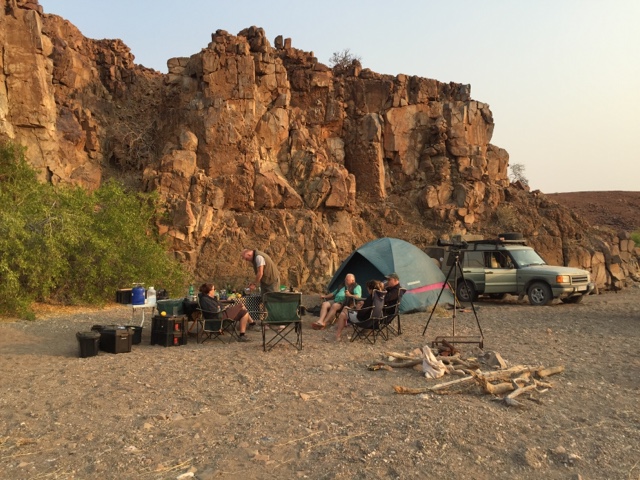
Day 17: Palmwag Concession to Sesfontein.

I woke to the sound of nothing, no loud Spanglish, not even a bird. I read for ½ an hour, then Gray and I got up, he lit a fire and we sat in the dark waiting for the sun to rise. A special time…. but not for long. The kettle boiled, George arrived, then the rest of the gang. Condensed milk coffee time in the morning is always a good catch up on how we all slept.
I had a hot bush shower (thanks Gray). Even a ‘boskak’- if joked about enough, it’s not so bad. I think I have gone over to the dark side, with the other girls edging towards the fence – I really enjoyed being self sufficient, in the middle of nowhere, with no one around.
We packed up, leaving only our footprint behind, and that would soon be covered by the desert sand. Our first sighting of the day – springbok again.
Once out the river bed, the terrain was stark and rocky with vey sparse vegetation. The track then led us into the valleys of a mountainous region, similar to the Kuiseb Valley. Here we passed another vehicle, the first we had seen in 24 hours. We then drove through the a river bed, a tributary of the Mudorib River. Stopping for a tea break, in a beautiful area, there must be underground water, as there are these beautiful old trees, that have survived for hundreds of years in harsh conditions. The drive through the valley was spectacular with lots of green trees.  We saw lots of desert giraffe, they are extremely light in colour.
Sue is a geologist and loved being able to see the different layers of rock in the surrounding mountains, free of vegetation (apologies to all geologically inclined – I’m know there are geological terms for the amazing areas in Namibia, unfortunately my knowledge on the subject is non existent, so I report it as I see it).
Our next stop was Amspoort Gorge, where we came across the first water hole in the park. Little water and lots of birds; we spent some time birding and admiring the view before heading into the Hoanib River bed for the next section of the days trip.
The Hoanib River Valley is truly spectacular.  We drove through a sandy river bed, filled with lush green vegetation and tall trees. We were dwarfed by high grey mountains and the odd sand dune. A great contrast of colours. There was lots of evidence of ellies, and then there she was a beautiful desert elephant foraging on the side of the banks. On the opposite side was a little steenbok.
At our picnic stop, under one of the tall old trees we saw lots of cat spoor. Then we saw springbok and a giraffe – this one was a lot darker than those we had seen before. Next, on top of a river bank, appeared 3 ellies. Two adults and a little one, I guess in this neck of the woods it would be considered a breeding herd.
Later we came across water, not a flowing river, but big pools surrounded by bull rushes, reeds and abundant with bird life.  We were fortunate to see Ellie again, a real breeding herd  this time of at least 10.
The only way to travel the Hoanib Valley is through the river bed and as the river was in flood on our last trip, we were unable to access the area. I am so glad we got to do it this time, it is a very beautiful and special place. I could spend weeks exploring this remote area.
On exiting the park, we went through 18km of very fine desert sand, it was like powder and we saw a herd of desert giraffe. We also had a few drops of rain.
The Camelmen loved their 4x4ing today; from rocks to sand to mud and water… but the valley driving was not the end of it !!!
12km to our destination for the day we hit a 100m hilly patch of deep talc sand. 20m from the end we bellied up on the fine sand, our chassis was stuck on a sand bank.  At the same time Tony radioed in to say he was stuck on the previous hillock. Spades out, wood collected, much revving but we were stuck fast. I tried to walk in the track and the sand took me up to mid calf. During all this it started to rain – in the desert!!!.  George managed to pull Tony out, the girls found the best route out for  him and then it was our turn for the Pajero Recovery unit. As this was going down Tony got stuck on the hill coming up to our Discovery. Three / Nil to the Pajero – yah George!.. And in the rain.
Sesfontein, named after the six fountains found in the area, is a tiny rural place with a few mud houses and lots of goats.  After checking out one or two of the local camp sites (literally clearings under trees with the goats). We selected Camel Top (the boys insisted on calling it ‘Camel Toe’), named I guess because we are camping at the base of a camel hump shaped mountain. The camp site is community based, they have gone to a lot of trouble to make it nice and we were happy to support them.
We were the only people around and settled down for our evening drink. First we were visited by a mangy little puppy and then a cape turtle dove.  Cotton had wound the doves legs together and it was struggling to hop around.  The next hour was spent, using various methods trying to catch the bird. Eventually, the guys succeeded in catching it and another 15 minutes freeing it and one happy dove flew off.
We had delicious Oryx steak, salad and homemade bread and ice creams for dinner – pretty decent considering we have been off the grid for 4 days.
There were some great birds in the area; we saw a Monteiro’s hornbill, crimson breasted shrike and went to bed to the sounds of a pearl spotted owl.

Day 16: Palmwag Concession

I didn’t have a great start to the day. I was woken at 04:45, with a headache (unusual and not caused by alcohol) by the Spaniards, clearly they had an earlier start than we did. Before my day, starts – anywhere – I have to have a shower, today it was coooold.
Gray has toured this area before and found camping spots in the bush to set up camp, his plan for this part of the trip…..however, with much pressure from the girls and extra planning along the way, he has found designated camp sites. So if we have noise and cold showers – we need to suck it up.
Having bought permits for the Palmwag Concession, we entered the area at 8:30. The concession is a protected wildlife area. Our first sighting was springbok. The terrain is rocky with interesting vegetation and the biggest Melkbos plants I have ever seen.
We were fortunate to have seen a herd of  desert elephants in the river bed. These ellies appear to have longer legs and slimmer bodies than their South Africa cousins. Next was a herd of mountain zebra, they have a white undercarriage. Then gemsbok, ostrich, giraffe, jackal, kudu – loving this game reserve, I was back in my happy space – lappet faced vulture, herds and more herds of zebra. 
At one point we were looking at this mirage (heat haze) ahead of us, it literally looked like sea in the desert. Before we knew it, we had 4 gemsbok galloping across the plain in front of us – such an awesome sight.
It took us 3 ½ hours to do 45km. It was a very pleasant drive through the conservancy, with some definite 4×4 areas, specifically in and out the rocky river beds. There are 8 designated camp sites, basically clearings, as you have to be totally self sufficient to camp here.  We stopped at ‘Camp 3’ for our picnic lunch.  The highlight, besides Al’s veldie, was George producing Magnum ice creams from his freezer.
The afternoon drive ended at Camp .. ‘In the middle of nowhere’.. in the dry Hunkab River bed (it was not a dedicated site). The area was desolate with very little vegetation and far less animals, fewer river beds and obviously less water. The only signs of life were sparsely scattered welwitchias. 
At around 3 we stopped in the river bed next to a cliff and set up camp.  The first thing we saw were lion spoor, we’ve had worse; we’ve had the actual lions outside our tent in Botswana and ellies and hippo in Zambia. The boys have been dreaming about this night (sorry for the girls – it was too far to go to any camp site). I have to be honest, sitting in the river bed, just the 6 of us, sipping on our drinks, watching the African sunset, this is a piece of heaven.
We finished eating around the campfire as the last of the daylight merged with the waxing moon. We were tucked up in our tents by 7:30, after another hard and exciting day.

Day 15: Brandberg to Palmwag

Considering my sleeping conditions, the desert floor is very hard, I had a fairly good nights sleep. We woke to a chilly winter morning and an amazing sunrise, literally a red ball rising in the east. After a shower and breakfast we disassembled the camp site. The first night of set up and take down is always a bit rusty but we were ready to leave by 8:30, after jump starting Tony’s car.  
Today we travelled from Damaraland into the Kaokoveld. 
The first stretch this morning was along a freshly graded road, what a pleasure. There is a fair amount of vegetation around. We came to a T-junction,  with the mountain behind us we turned left to Khorixas. We passed villagers of Hereros and Ovahimbas posing on the side of the road. We passed over mountainous regions with a variety of biomes, including areas of euphorbia and mopani. 
We stopped for a quick leg stretch, George headed off to find bird species, the girls discussed welwitschias – so academic – and Gray & Tony had the bonnet of Tony’s car open, sorting out battery systems.  Al joked that that the Discovery driver has spent lots of time fixing the Prado.
On entry into the Khorixas  District we crossed the dry river bed of the Ugab River and into an area with Mopani tree vegetation.The area is more populated, the main mode of transport is donkey cart.
The last 8 km into Khorixas, was on tar. It is a neat, clean rural town. We stopped for fuel and headed along a hilly dirt road to the petrified forests. This morning we decided to forgo an arduous 2 hour mountain hike to visit the rock painting of the ‘White Lady’. We were however very happy to take the 800m tour of the Petrified Forest. A forest, it is not, it is dry and rocky and fascinating. The area boasts petrified pine trees that were washed down into the valley 280 million years ago. There are various minerals embedded in the wood. It is also an area of fascinating flora. The guide got a little concerned when I backed into a euphorbia bush (to take a pic), the poison of which is used by the bushman to dart animals. There are also a number of Welwitschia, but they are are smaller than those we saw yesterday. Our guide explained the difference between the male and female and their form of pollination. We really have become fascinated with these plants. We saw a few bird species and an agama (gecko).
The next gravel road stretch took us over an attractive mountain pass to Bergsig. We saw ellie dung but unfortunately no ellies.
Our final destination for the day was Bergsig. The town consisted of a few buildings, no shops or other amenities. Here we passed into a veterinary controlled area – we are not allowed to take meat or animals out this area – animals won’t be a problem.
We camped at Palmwag under some beautiful….palms. After setting up we went for a walk along the river area. It is luscious and green along the river bed and we saw an elephant in the distance.  
Unfortunately an overlandtruck full of Spaniards arrived that evening and camped next to us. They were rather loud.

Day 14: Swakopmund to Brandberg

We left Swakopmund around 9, after filling up with diesel and water and making final preparations for the next leg of the journey – a 5 day trip to Epupa Falls. Today’s journey was 300km to Brandberg.
As we left Swakop, the sun came out for the first time once our arrival in the town. The first stretch out of Swakop was a 70 km drive, on a salt road, past Henties Bay. We passed salt pans and a salt works near to the sea, on our left. Then we came across miles of beach littered with ablutions, I thought this rather strange, until Gray explained that this was a popular camping area in summer. Next was either Mile 14 or Wlotzkbaken, I’m not sure as it was not signposted, but it was a quirky area with a colorful array of houses. To our right was flat desert area dotted with a seaweed looking type plant.
This area is not called the Skeleton Coast for nothing, we stopped at the Zeila Wreck, a fishing trawler that was stranded, almost to the day, 7 years ago. It was sold to an Indian Company for scrap, but came loose from its towing line on the way to Bombay. It cannot be rescued any further, as it lies just off shore. We walked down the beach and I dipped my feet in the cold Atlantic Ocean.  The wreck has become a bit of a tourist attraction and there are peddlers selling stones and crystals. Unfortunately, one of them stole George’s slops that he had left near his car, we left the area decidedly irritated.  Our first bad experience in Namibia.
From Henties Bay we headed north along the coast to our next via point, Mile 108. Along this stretch we passed more salt pans on the sea side and the area to our left was covered in black dunes – dunes covered in black volcanic rock. There were homemade tables with large salt crystal chunks with honesty boxes dotted along the road.
We turned left to Cape Cross Seal Reserve. The history of which is important as it was thought to be the point of the first European landing in January 1486 by Diogo Cao/Diego Cam. He was a navigator under the command of King John 11 of Portugal. He was probably attracted to the coast by the mass of seals and erected a limestone cross. The original is in a German Museum and a replica resides in its place. The seal colony consists of thousands of seals basking on rocks and on the sand. The surrounding sea is also filled with seals, surfing the waves, at first I thought I was looking at kelp.  The smell was disgusting and left you with a metallic taste in your mouth, there was also a continuous plaintive, baby like, cry that permeated the colony. Despite this we spent a good ¾ of an hour ogling over them. 
My experience with seals has been rather hairy at times. I was once attacked by one, while scuba diving on a wreck, at 30m in Hout Bay. Luckily he preferred my pink fins (that bear the scars of his teeth marks) to my blue wet suit.
Back on the road we passed Doep se Gat, Predikant’s Gat, Adri se Gat, Bakleigat and so on. They are just names on a map and fishing sites, I guess, as there is nothing there but a barren coastline.
At Mile 108, there are 5 basic holiday chalets, we turned right onto a gravel road, leaving the sea behind us. A few kilometers down the dark grey/brown road we were rewarded with pronking springbok. It is a miracle that they survive out here, the area is reminiscent of pictures of the surface of the moon.
We stopped to take pics of the amazing welwitschia plants. The plant is endemic to this area. It is a unique plant and is protected by Cites.They live between 1000 and 2000 years and the leaves grow from 2m to 4m. The plant grows only 2 leaves over its lifetime, the bunches of leaves seen are actually splits of the original pair. It was a pleasure to have some respite from being rattled around on the badly rutted gravel road.
Sometime later, in the middle of nowhere, we took a sharp right turn onto a track, to the middle of nowhere …. The road was so bad we were traveling at around 20km an hour. We did eventually land up at the Messum Crater, after having stopped for a picnic lunch around 1 o’clock. Yesterday’s homemade rolls and Marula drink tasted great. The road to the crater was lined with various sizes of welwitschia plants.
We stopped at Bakkrans, an historical cave sight at the side of the immense crater that was hit by a meteorite millions of years ago. We then headed along the crater floor, surrounded by mountains, probably pushed up by the blast.
The journey continued, a fair amount of the time, we had no tracks on follow, we were following GPS coordinates. At one point we rounded some mountains and Brandberg, our destination and Namibia’s highest mountain, could be seen in the distance. The route around the huge mountain took us the rest of the afternoon and travel weary, we arrived at White Lady camp site at 5.
Rather than camp in the middle of nowhere, or rather somewhere at the base of Brandberg, we elected to drive on for an extra 50km to a camp site attached to the White Lady Lodge.  We had dreamed of seeing one of the desert elephants, rhino or lion. It was only a dream … as we arrived at White Lady, there was a desert elephant foraging in their garden area. We were warned that he had trashes 2 tents the day before and to be careful about leaving food, specifically fruit lying around.  Undeterred we set up camp in the bush, had a great braai and were in bed by 8:30.
Much as I enjoyed and appreciated the great restaurants, shops and comfortable bed in Swakopmund, lying here on my thin mattress on the hard desert ground – I can’t help thinking that today I had explored well – lived life to the full.

Day 13: Swakopmund and Walvis Bay

I love the boat harbour trip around Walvis Bay.  We have seen amazing bird and sea life, including a southern right whale. Unfortunately the weather was windy and inclement this morning and we would have been wet and cold if we had gone on the cruise. We therefore had a chilled start to the day before heading off around 10:30 to explore Walvis Bay.
The city of Walvis Bay (meaning Whale Bay) lies along the bay, which is a safe haven for ships because of its natural deep water harbour and has a colorful history, having been administered by South Africa for many years.
Our first stop was Pelican point, where we spent some time watching the thousands of pink lesser flamingo and their cousins, the white greater flamingo. We also saw pied avocet, a greenshank, gulls, ducks and other species. The area around Pelican Point is definitely upmarket part of town and has big beautiful houses. The town doesn’t boast any of the German influence of Swakopmund and is more like a South African seaside town.
We then wondered off to the waterfront harbour area where we pottered around the few tourist shops and settled down for a lunch of oysters and calamari at ‘Sarah se Gat’ pub on the water edge. We watched boats come and go and were visited by Pelicans. There are a number of oil rigs that have been anchored off shore, they apparently are too expensive to run at present.
We were excited to have George and Sue arrive this afternoon to join us for the remainder of the trip.
We went to the German ‘Brauhaus’ for dinner – long awaited for by Graeme.  I had booked a reservation 2 weeks earlier to ensure we had a booking.  With beer boots and eisbein for the boys for diner – the evening did not disappoint and a good time was had by all.
(Tomorrow we head into off for 5 nights of desert camping and communications will probably be scarce).

Day 12: Swakopmund

Today was what we called on our Serengeti trip, an admin day; washing, shopping, repacking, restocking, checking the routes ahead and so on.  
Swakopmund, sandwiched between the cold Atlantic and the Namib dunes, has a distinctly German hospitality and flavor and is definitely the best place in Namibia for an admin day. Our first stop was the Namib butchery for meat and biltong, then onto Woolworths – a disappointing food section as they had no fresh produce but we still had Pick n’ Pay, Super Spar and the German Supermarket to check out. Shopping was the easy part, we then headed back to Lifestyle Apartments car park for the big pack up. The meat into the freezer in our vehicle, the fresh produce into the Purchase’s fridge – it’s always a fight between the boys (beers) and the girls (lettuce) on a trip as to who gets fridge space. The non perishables we store in black ammo boxes.
The easiest part about this admin day was the washing. We put two weeks worth of dirty, desert sanded, clothes in bags and sent them to the apartment reception in the morning and fetched them the evening. Some little fairy had been very kind and done it for us – we haven’t got the bill yet but whatever the cost, it will be worth it.
Admin done, it was time for lunch and exploring the town (ie shopping for Al & I). We had a bite to eat at a coffee shop (I guess it must have been German as the guys had bratwurst and sauerkraut). The town is a colonial remnant of Germany and the people are a quirky mix of German, Namibian and tourists, predominantly German – who must feel right at home. I get the feel that Swakop is predominantly a holiday town; with it’s seaside promenade holiday homes, colonial-era buildings and lots of hotel construction.
Al and I had to wait till 2 to start shopping as most of the shops close over lunch hour.  Then we walked the town flat, I was exhausted by the end, not being as seasoned as Al when it comes to this particular exercise – Kirst you would have been proud of me. Gray went off to arrange permits for the areas we will be entering on the next leg of our trip. Tony went paddling, he found the only 2 paddlers in Swakop, arranged a surf ski, and set off for an  1 ½ paddle in the cold sea. We headed off to the beach around 4:30 to watch him come in and I was freezing just standing there.  We have had overcast, miserable weather since we arrived. Gray had been on a drinks stock up at the bottle store and had bought some very interesting Namibian drinks. We sipped on Jimmy Jaggas – fruit spritzers and some delicious Orange hops drink.
We went to the Tug, a restaurant at the seaside, for dinner. Best seafood ever and highly recommended. Another great day in Namibia.

Day 11: Sossusvlei to Swakopmund.

Happy Birthday Julie  – Best Sister in the world
We left Desert Quiver camp at 8:30 for the 340km drive to Swakopmund. Our drive out the Sesriem area was again on dirt roads. We soon entered the mountainous  Namib – Nauklift Park. Some of the mountains are oddly shaped with different rock types dominated by various colours – a geologists dream. The vegetation is again yellow tufts of grass, sprouting out of a grey clay hard ground, interspersed with green, brown and grey hardy shrubs. We then entered the Windhoek District the terrain, although the mountains were in the distance was much the same. 
We passed Solitaire, a petrol station and general dealer ‘town’. They had a whole lot of old car shells littering the entrance.
At 10:15 we crossed the Tropic of Capricorn. Shortly after this we went over the barren mountainous  Gaub Pass and passed over the dry river bed of the Gaub River. There are long cliff drops into the gorge below, with no guard barriers. If we went over the edge, I’m not sure if we would have been found. The long flat roads became windy and hilly after the Gaub Pass.
On entering the Swakopmund District, we hit a tarred road for 2km and then it was back to dirt roads. The mountains are strange shaped inselbergs with hewn rock faces, caused by millions of years of wind erosion and tectonic plate movement. It was a rather hairy descent into the Kuiseb River valley. We stopped for a picnic at the causeway to the river, having driven over the river bridge a few km earlier. In April, 4 years ago, this now dry river bed was flooded and the water almost covered our tyres.
We then passed into the recently proclaimed Dorob National Park, that extends around the Swakop area. You require permits if you leave the main road to explore areas of the park. The terrain is flat and arid. We were fortunate to see mountain zebra.  The final stretch of long flat road into Walvis Bay was totally arid. The only respite was an interesting rocky outcrop – the Volgewelgeberg.
Around 10km out of Walvis the coastal clouds rolled in and the temperatures dropped. Small beach sand type dunes paved the way into Walvis, until you actually enter the town and then roads are lined with palm trees.
We had another TrenTyre stop in Walvis so Tony could replace his other tyres. The road out of town was again lined on both sides with palm trees. The 30km drive to Swakopmund was along a tarred road with the sea on our left and white sand dunes on our right. There were lots of holiday houses and housing developments on the sea side. I can’t believe the development in the last 4 years.
We arrived at Lyfestyle11, in Libertina Albathuli Ave, a 3 bedroom apartment block and our home for the next 3 nights. 
After a chilly walk along the promenade, it was great to see the sea after so much desert sand, we headed off to the Jetty for dinner.  The Jetty is a restaurant , that was establishes in 1905, and is built at the end of a 300 jetty, over the sea.  Over a wonderful dinner, we swore we could feel the building move as the waves crashed around us. 

Day 10: Sossusvlei

Yay We woke at 5:30. Condensed milk coffee, shower and we were on our way to the park gate that opens at 6:30.  Desert Quiver Camp is only 3 km from the main gate, I couldn’t believe the amount of traffic passing the camp between 5:30 and 6:30 – it was like a national highway.
Once passing through the gate, we travelled 60km from the park gate to the dunes on a tarred road. The area was flat with the Naukliftberge on our left and the red Sossusvlei dunes on our right. As we drove further into the park, the red dunes took over and we were privileged to witness the tallest dunes in the world. Sossusvlei is known as the Namib Sand Sea, a desert region encompassing a diverse array of large shifting dunes.
On our previous visit the sun beat down on the orange red sand lit up the blue sky, giving us awesome photo opportunities of the two colour tones. Today however we drove into mist, for kilometers, obliterating any view the dunes. We had left early to avoid the heat of the day – it was 9 degrees outside 😅. Nature is wonderful, unpredictable and has a mind of its own. We have travelled over 3000km so far – to see one of my favorite places and all we have is white mist surrounding us.
“Arriving at viewpoint ‘big daddy’ dune on right” – in the words of the GPS. Not that we could have missed it, there was a car park full of 4×4’s. The previous 5 km we had travelled  on a very sandy 4×4 only track. There is a car park and non 4×4 vehicles have the option of catching a shuttle ride in. I am amazed at the thousands of people visiting the dunes, even at the peak of tourist season.  Last time we were one of 2 vehicles in the area. This is Gray’s 4th visit to Sossies and he talks about driving up the dunes and into areas that are now out of bounds.
By the time we started hiking up the dunes the mist had lifted but we never got the clear perfect blue sky today, making the dunes less red but no less majestic, just different. We spent 3 hours hiking up dunes and looking down into pans (Tony going higher than the rest of us). The final walk was into Dead Pan, a clay grey pan full of dead trees, surrounded by dunes that make one feel very minuscule.
We returned to the busy car park and headed into a more secluded area for a well deserved picnic, sarmies with last nights left overs, under a Kameeldoring tree. It is amazing how life can flourish under a tree in the desert. We were visited by sparrows and tit warblers. The tree itself has amazing green twirley seed pods.
We ambled back taking pics and sorting out an electrician for a blown fuse box back home.
We arrived back at Desert Quiver Camp around 2 and went for a well deserved swim in a very cold pool. Bliss – Gray say stupid.  The afternoon was spent sipping shandy’s around the pool in the desert.
Another awesome braai with red wine.  Life is Kak in Africa ❤️

Day 9: Aus to Sossusvlei

Happy Birthday Kirst 🎈🎁🎉. OMG we have been made to feel so guilty for not being at home for the Big 23.  We will have lots of 🍷🍷🍷later to celebrate.
After a big breakfast, we packed up and hit the road at 9 for a 340km, dirt road, drive to Sossusvlei.
 
As I have mentioned the roads are in a great condition. There is constant maintenance on all roads. You regularly see graders smoothing the dirt roads. The drivers live in mobile homes that they move along the vast distances with them.
After about 60 km, we headed into the Namib Biosphere Reserve, a  mountainous area that has more vegetation than we have seen in days; tufts of grass, thorn trees and succulent shrubs.
After some way we were treated to the beginnings of the tall red dunes of Sossusvlei. The scenery in the park is truly spectacular and varies from yellow sandy dunes to grey jagged mountains.
On entering the Hardap region, we saw more mountains and dunes. I am awed by the vastness and remoteness of the area. 
We have slowly been adding to our bird list, looking forward to having George and Sue join us on Saturday, then I know our list will increase dramatically. Today we have seen a pale chanting goshawk, we have seen many of them along the way and a new one to add to this holidays list, a Ruppell’s Korhaan.  Most impressive however, were the large sociable weaver nests in the trees.
We entered a cattle farming area and passed through the intersection at Spes Bona, a farm with an impressive cactus garden. Last time big white cows littered the road, stalling our way through. This time a herd of brown cows were corralled in an enclosure. Missed the white cows. We stopped at the next  farm, Betta, for chocolate milkshakes – I haven’t had one in years, it was so nice.
On our previous visit to Sossies, there was a parks board- pack packer type camp site, a nice site with a pool and expensive lodges. We enjoyed our stay at the nice camp site. I can’t believe how many accomodation options have since opened up and how difficult it is to get bookings. Gray managed to eventually get a booking at Quiver Tree Camp.  What a find – these self catering units have only been open for 2 weeks and are modern, well designed  and very comfortable. They have a pool and bar area and will supply food to your chalet.
The 340km took us about 6 hours and we arrived in temperatures of 30 degrees. It is always nice to have a decent place to stay when you are hot and tired.
Sitting on our patio, sipping G & T, watching the sun set over the desert with with the mountains of the Naukliftberge in the distance – there is a lot right in my world. Happy Birthday Kirst, thinking of you, wish all you kids were with us. Thanks Juls and Adie for playing mommy and daddy while we are away and especially tonight. 
We started the braai as the final bright red ball of sun slunk behind the mountains, no camera can capture the spectacular colours of an African sunset. Much as I have enjoyed eating in restaurants, nothing beats sitting around a fire with good friends.

Day 8: Aus, Kolmanskop and Luderitz.

Apologies to Gareth and Kirst for an oversight in my previous blog – I wish you were with us, as well as Robs. Thanks Kirst for bringing this to my attention, in no uncertain terms.
We set off just after 8 for the 120 km drive into Luderitz, stopping off at Kolmanskop on the way.  In the Garup area we were treated to sightings of the wild horses close to the road. Garup was once a station on the railway line between Aus and Lueritz. Because there was no drinking water in Luderitz, water was transported in barrels by train to the coast.  Luderitz only received its own pipeline in 1990 and the station was closed. We drove past the station house, it is still standing but in a state of disrepair.
We were fortunate to see numerous gemsbok, springbok and ostriches on our drive this morning.
This is my second trip to Kolmanskop (Robs messaged us this morning about how jealous she was not to be with us this time – Kirst I’m sure you would also have loved to have been with us 😂). It is a place that I could spend days exploring. I love this ghost town, about 10km out of Luderitz, situated in the Sperrgebiet (forbidden territory). After diamonds were discovered in the area in 1908, the town developed into a bustling centre, providing workers shelter from the harsh Namib desert. Some large and elegant houses were built and it resembled a German town with an impressive array of amenities. Richer diamond deposits were then discovered near the Orange River and its inhabitants moved south. Within the space of 30 to 40 years Kolmanskop lived, flourished and died.
Today the ghost town is full of crumbling ruins, as the buildings are being reclaimed by the desert dunes and we are left with a fascinating reminder of the former glory of the town. We spent a couple of hours exploring the old buildings. 
In Luderitz, Gray and Tony went to the tyre shop to sort out a new tyre, while Al and I explored the town. It is a coastal town on an extremely inhospitable coastline.  On our last visit it was very misty and this time it was very windy. The architecture has a German influence and there are old houses and churches dating back to the early 1900,s. 
We had lunch in town. Gray and I  have been craving Luderitz Oysters and they certainly didn’t disappoint.  
We had an extremely windy trip home, with the wind whipping sand across the road.
We have had a wonderful time in Aus. I am going to miss it.