Day 27: Kang: Botswana to Home: Sandton, South Africa

We left Kang at 8:00, after breakfast and refueling. The trip home took us via Jwaneng and Kanye, which was bigger than I expected, to the Border Post, then into SA, via Zeerust and Rustenburg – it was around 700km. The road to Jwaneng was again more like driving along a farm road than a highway. We had donkeys, cattle, ostriches and goats all over the road.
We had a quick and painless border crossing  at Pioneer on the Botswana side and Skilpadsnek on the S.A. side. It looks like they are in the process of building a drive-thru border post, that makes sense. We can’t complain however as we are still the only African country we have been to that is computerised.
The road into Zeerust was very busy, we are not used to traffic. It was also cold, 12 deg, and overcast. After Zeerust, the heavens opened and we drove in rain for most of the way home. It was nice to get home, the animals were pleased to see us (except Morgan, the cat, who will punish us for at least a week). Can’t wait to catch up with the kids: Ga was at work, Kirst away on a business trip and Robs still in Stellenbosch.

Day 26: Etosha to Kang in Botswana

We woke at 5, forget the sunken bath, nothing beats a hot outdoor bush shower. We wolfed down breakfast at the restaurant.  They have a system here where breakfast is included in the price of the room. Filled up with diesel, checked out and drove out of Namatoni at 6:30. 
It was a 10km drive to Von Lindquist Gate. Gray and I have been looking for Damara Dik Dik for 3 days and we saw 3 on our way out – typical. At the gate we and the car were foot and mouth decontaminated: we had to walk over the disgusting wet carpet, while the car tyres were sprayed.  I know this is a serious business but the irony is I was wearing talkies that I had not worn since entering the area and my slops that I had been wearing will arrive home full of Etosha sand.
 
We drove toward Tsumeb and then onto Otjiwarongo and then took the C30 to Gobabis. I was very surprised at Otjiwarongo, it is a neat, tidy town and a whole lot bigger than expected and more modern than I expected. It means ‘pleasant place’ or ‘place where fat cattle graze’, I didn’t see any fat cattle but it certainly was pleasant.
The scenery along this mornings drive was pretty, with lots of trees. We passed a number of game farms and loads of warthogs foraging on the side of the road. The tarred road to the C30 was a good road.  The C30 to Gobabis was 320km of also good dirt road, it bypassed Windhoek and shaved around 120km off our journey. It was an area of farms, game and cattle, lots of grass and trees – we have left the desert areas behind. I thought we might be dodging donkeys on this stretch of road but it was wildlife, at one stage a gemsbok ran across the road right in front of us.
We crossed over ‘Die Dam’, a dam about the size of Emmerentia and entered the town of Gobabis, it has all the amenities of a busy town: like Vleis Paleis, Pep Stores and a Street Style Fashion Store, to name a few. We elected not to stop at the ATM, Fuel Station and Take-away, the queues were hectic. We pushed onto Buitepos, stopping to change a tyre 10km before the border. I thought it was too good, getting through Namibia without a puncture.
We filled up with diesel at Buitepos and drove 2km to the  Mamuno Border Post between Namibia and Botswana. We arrived at around 2:45 and left around 4:15, it took around ½ an hour but we need to set our clocks forward an hour.  If we had done the border crossing tomorrow, we would have been in the same zone, as Namibia reverts back on the first weekend in September.
If we thought we had problems dodging animals on the Namibian roads, we had bigger ones dodging livestock in Botswana.  There are no farm fences and the cattle, donkeys and goats cross the main road at will, it is very dangerous.
Four very weary travelers arrived at Kang Ultra Lodge around 7:30, we had been traveling for 12 ½ hours. We had only stopped for fuel, a tyre change and a border crossing and hadn’t eaten a meal since we had inhaled breakfast at Namatoni.  
Kang Ultra Lodge is a great stop over on your way to or from Namibia or into Northern Botswana. It is a clean and comfortable overnighter, with a restaurant next door. After dinner we fell into bed.

Day 25: Etosha: Halali to Namutoni

We woke up early. Al and Tony are heading home and George and Sue went to the waterhole, leaving embarrassed Morries behind. We had a delicious breakfast in the restaurant and set off on the 70km drive to Namutoni, along the pan.
As we left camp, our first sighing was the black faced Impala, they have a black strip running from their forehead to the tip of their noses.The sweet grassveld and mopani treeveld on the side of the road was totally grey for around 50m, caused by the dust from the limestone road, then it reverted back to it’s natural state.
The word ‘etosha’ means ‘Great White Place’. The park was proclaimed in 1907 and covers around 22 912 square km. The Pan itself, covers 4731 square km (110km at it’s widest by 60km). The pan is mostly dry, except when the Morrison’s visit – and in the rainy season. There are permanent springs in the southern section, fed by porous bedrock which permeates out onto the clay floor of the pan. We took a 3km detour off the main road to Etosha Lookout. Standing on the edge of the pan made one realise just how enormously vast and desolate this area is, devoid of all life. It was white clay from horizon to horizon – a spectacular view.
Back on the road we saw a flock of 40 ostriches, white rhino, a couple of herds of elephants, lots of before mentioned enteral game and more black faced  impala. It was fascinating to see springbok and Impala grazing together. Another fascinating observation was the vast numbers present in the herd – 20 odd giraffe together, herds of 30 to 40 kudu and so on.
We sat at Chudop waterhole for a while watching 3 big male elephants drink, with herds of zebra and kudu waiting their turn. We then headed into Namutoni  camp.
Namutoni camp was originally a fort built in 1902, destroyed by the Owambos in 1904 and rebuilt in 1906, it is a national monument. The waterhole in the camp was first noticed by John Anderson and Francis Galton, the first Europeans to discover the camp in 1851. We stayed in a very comfortable chalet, with a sunken bath and an outside shower.
As the afternoon started to cool, it was 35 degrees, we went for a sundown drive around
Fischer’s Pan, it was a beautiful drive and strange to see palms trees at Twee Palms. An ellie was scratching himself against the palm, when a lapped faced vulture landed in it, the ellie banged is full weight against the tree and poor vulture was knocked off his perch and flew away squawking madly.
We ate dinner at the restaurant, at one of the outside tables, and we were visited by a jackal. I went to bed with a heavy heart, this was our last night of real holiday, tomorrow we begin our nearly 2000km journey home.

Day 24: Etosha – Olifantsrus to Halali

“After a good nights sleep, I headed off to the showers. Being kind of a bunny hugger I really appreciate the whole Eco camp philosophy, that is until you have a cold morning shower, as the solar power hasn’t worked its magic at 6 in the morning. Olifantsrus is a nice camp but we felt they could have done more – they could have made the camp areas a little more private and had more showers.
After coffee we packed up and went back to the view site. As the area is so dry, the waterholes are all teaming with game and birds. This morning I added kudu, jackal and another 3 birds to our list.
We left camp for the 190 km trip around 8:30. We stopped at all the waterholes on route, they are usually a few hundred meters off the road. You soon got to pick up which waterholes had water and which didn’t, those that didn’t had no  signs of life around. 
At Sonderkop waterhole we saw more animals around the small water hole than I have ever seen: herds of red hartebeest, zebra, springbok, gemsbok, wildebeest, warthog, ostrich, jackal and guinea fowl all crowded around, waiting for their turn to drink before loping off. There was no vegetation for hundreds of meters around. There was definitely a sense of agitation as the animals waited their turn, the plaintive cry of the wildebeest and the bark of the zebra were most prominent.
At the next waterhole,Ozonjutji m’Bari, we again had herds of zebra, gemsbok, wildebeest and springbok. There was more water and the atmosphere was less frenetic, which was surprising considering there were 3 lionesses under one tree and a mating pair under another – the male was huge with a black mane. What a life, food and water on tap – it would be like Kirst living next to Sandton City.
We stopped at Okaukuejo, with it’s big castle turret like structure for lunch. The last time we were here here, I climbed to the top of the castle with Robs. I gave her a call, nice to have reception in the camp, and was relieved to hear the doctor was happy that she was on the mend. She was more concerned about the effect of being on meds on her social life and thought it ‘sucked’ because she was not with us.
From Okaukeujo we headed past the southern section of the pan. On our last visit the pan was full of water. We also added elephants and birds to our list along the way and we saw some big sociable weaver nests. 
At Halali, we met up with Al and Tony again. It is really nice camp, reminds me a lot of the Kruger National Park camps. We did another sunset hide visit, at this one you sit on a bank of rocks overlooking the waterhole. We arrived to a herd of ellies and a black rhino drinking. It was fascinating to see a standoff between the two. Our memories of this viewing will be somewhat marred by my usually law abiding husband not taking much note of the ‘Be Silent’ sign; a noisy drinks pouring session, followed by his pinging cellphone, then the loud sneezing, topping it off with a fart – and very dirty looks from all around.
We slunk back to our very comfortable hut for chicken potjie for dinner.

Day 23: Swartboois drift to Etosha – Olifantsrus Camp

I was wakened by the chirping of the thousands of chestnut weavers in the tall reed bed outside our room. What a great way to start spring.
We left the Kunene River lodge at 8:30 and travelled 48km to our first stop, Ruacana Falls. We passed a number of nomadic Himba villages, then through a mountainous area, with some pretty steep roads and back into dry mopani regions. During this section we clocked over 5000km on this trip so far.
We came over a mountain and the Caleque Dam and Ruacana Hydroelectric scheme were across the valley on the next mountain. The section from the hydroelectric power station to the falls was on a tar road, our first in a long time. 
The falls were a touch disappointing, as the rock face with cascading waterfalls one sees in pictures were completely dry.  There was a section of waterfall lower down to our left of the cliff face but nowhere near as impressive as Epupa Falls.
Our next stretch was 20km on tarred road into Ruacana for fuel and to buy a new battery for Tony as his has been flat for the last couple of days. It is also here that Tony and Al head off towards Namatoni in Etosha, they are changing around the last few days of the trip to arrive home earlier.
At Ruacana they had a decent fuel station, with a general dealer store with arb items, like back scratchers. Tony managed to get a battery, while he and Gray installed it, George spied out birds – at the fuel station :). The town from what we could see were mainly pre-fab structures, post war relics I guess. I chatted to our girls – bit concerned about Robs who has an infection in the bone between her brain and ear, but she is on medication and ensures me she is fine.
We passed the Ruacana Air Force Base and turned right to Otjondeka and Kumanjab, the others carried on straight via Oshakati to Namatoni. George and Sue are only going 50km on the Oshakati road in search of the Grey Kestrel and will double back to meet us at Olifantsrus. We are going ahead to secure a nice camp site for the night. We were pleasantly surprised to find the road newly tarred took us the whole way to Etosha. The road was however not plain sailing, the speed limit of 120km/hour didn’t apply as we were constantly stopping for cattle, donkeys and goats to cross the road – it was probably more dangerous than the mountain passes. There was however very little traffic.
The area was again mainly mopani vegetation, so dry the majority didn’t have leaves. There were small areas of Himba populations, where the Ovahimba women had cultivated small field of mohangu. The temperature was 31 degrees, it goes up to around 45 deg in summer.
I guess it has been school holidays, during our trip, as all the schools along the way have been closed, except for the odd bush school lessons we have seen taking place.  Today, however we noticed a few children walking along the road near one of the small towns in school uniform – no mom’s 4×4, au pair or even a taxi.
At Werda, we were stopped at a veterinary control point. They sprayed our tyres and we has to walk over a wet mat. They checked our car fridge for meat, as were not allowed to take meat through due to foot and mouth. We had stopped earlier and hidden chicken and sausages on the roof rack, amongst the camping equipment. These  items are permitted but we didn’t want to take chances with our dinner. 
We arrived at Gallton Gate at Etosha around 2:15, booked in and paid. Gray then spent the next ½ hour assisting a Cape Town couple pump up their tyres with his portable pump. The first few kilometers along the white dust road was still mopani, then it opened up into beautiful bush area; yellow grass littered with typical African bush trees. We didn’t see much on the road but the water holes were a different story. At one we saw a black rhino (minus horn), wildebeest, red hartebeest, springbok, zebra and a giraffe.
Olifantsrus, is an old elephant culling station, that has been turned into an eco campsite. They have an amazing double story hide overlooking a waterhole. We headed up there for another amazing African sunset and to watch the animals come down to drink. 
We then set up camp and started dinner. As we are nearing the end of our journey, so are our provisions. We also didn’t have Al keeping control – she would have platzed at our less than gourmet attempts.  Firstly, no table cloth, the delicious meal of Russian sausages, cheese wors with mustard sauce and beans with chilli, garlic, ginger and anything else we could find was all eaten straight off the braai and out the pots – no plates to wash !!
The boys headed off to bed after a long days drive. Sue and I returned to the hide, where they have a red light illuminating the area. We saw brown hyena, black rhino, eland and marsh and barn owls. All in all, today was a great start to our animal viewing list in Etosha.
My camp mattress is getting more comfortable or maybe on our last night of camping I was just getting used to sleeping on the ground, or more likely it was listening to the sound of laughing hyenas and my favorite sound of the bush, roaring lions, and they were close.

Day 22: Kunene River Lodge

We had breakfast on the deck, overlooking a perfectly clear river, the past few mornings have been a bit hazy.  Today the greens were greener and the water more sparkling.  We had a chilled start to the morning, I spent some time in the only wi-fi spot –  an open thatched roof hut, that I shared with an Angolan fruit bat  – painstakingly trying to send off blogs. All comms is soooooo slow here.
Around 10:30, George and Sue took a drive to the Ehomba area in search of the Cinderella Waxbill, a little-known bird with a restricted range in this area. Tony, Al, Gray and I hitched a ride a couple a kilometers upstream with 2 x 2 man croc rubber dinghies. The trip started off really well with me slipping down the muddy bank and landing up full of mud, much to amusement of the others. We spent the next few hours drifting and paddling down the Kunene River to the lodge.
Feeling a little rebellious, we paddled across to the other side and touched Angolan soil, unofficially, a first for me and Panda is making a habit of it, having done it regularly 35 years ago. The vegetation was less jungle like, with fewer palms and more acacias, leadwoods and thorn trees.  We saw lots of water birds but the highlight was a crocodile slithering into the water about 2m from us and swimming under our dingy. I loved this morning on the river.
We returned to a delighted pair of birders who had seen a whole flock of Cindies and a whole herd of other birds. The girls spent the afternoon chilling around the swimming pool and the boys pottered around the camp, sorted out car maintenance and read.
At 5 we walked down to the river, boarded the boat and headed upriver on a booze cruise.
I love being on water, especially cruising on African rivers, another really happy place for me. On our way up the Kunene, the sun went down through the Africa bush, leaving us with a gentle hue of pinks and blues.  We crossed over rapids and ended at a mini waterfall, in the rainy season, they would form a more hectic section of rapids. Along the way way we saw baboons and crocodiles – bit stupid to have been swimming in this river – and BIRDS.
As you may have gathered, a number of my traveling companions are bird mad. I love birds too and keep a bird list for each trip, enjoy the summer migrants and get a thrill out of seeing something new and special. Big birders, however, take it to a different level…there are other species out there; mammals, reptiles, amphibians and plants and trees. Our skipper for the trip was Peter Morgan, owner of the lodge and ornithologist. Our reason for arriving back in camp long after the sun’s rays had said goodnight was that we stopped numerous times for birds. I really didn’t mind as I loved the scenery while sipping on my Gin and tonic. However, I would liked to have spent at least a few seconds looking at a baby croc I had spotted on the banks (clearly I was looking down, not up). At our next bird sighting, in the dark, there  were a troop of baboons roosting in the next tree, despite mentioning this twice, all lights and binoculars were on the birds – turned out to be Angolan fruit bats. As we set bank off down the river, my birder friends just smiled at me indulgently. I really do admire their passion and at times it is infectious but I haven’t moved over completely, I still have an affinity for the animals who keep their paws and hooves on the ground.
Another Kak night in Africa; great meal, red moon rising, awesome mates and a wonderful husband.

Day 21: Epupa Falls to Swartbooidrift – Kunene River Lodge

The big decision about today was which route to take from Epupa to Kunene River Lodge. The first option was to follow the river, a pretty route, for around 80km. Option 2 was 160km, retracing our route in for 70km, with little change in vegetation along the way.  Option 1 sounds like no brainier, however, upon investigation, we got various reports but the jist was the first 20km to 30km was on a newly made good road, then about 20km of track, followed by around 15km of real rough, tyre wrecking stuff. The total length of the trip, according to various reports, varied between 5 and 9 hours. Option 2 around 3 ½ hours. The clincher to take option 2 however, was the report from the head of the road construction company, who was also staying at Epupa. Construction had been halted as they had come across land mines, remnants from the bush war. He was up here to meet with the Namibian Police regarding having the area swept and demined.
We set off around 9:15, passing the Zebra Mountains on our way to Okangwati. From there we turned left,  retracing our steps on the Opuwa Road. Then we turned left towards Swartbooidrift, where we stopped for our first break, with the goats and cows. Or so we thought, next thing we had some local children come begging. We gave them pens and pencils but they asked for anything they could see in the car.
The terrain along this road was rocky, with no ground vegetation and littered with mopani trees and Himba villages.
Three kilometers from Kunene River Lodge, at Otjitunda, we stopped at the memorials and graves of the Dorsland Trekkers. The history of Namibia is as interesting as it is difficult and at times cruel and violent. The story of the Dorsland Trekkers (Thirst land Trek) I found particularly interesting. It took place from 1880 onwards, with Boer settlers from South Africa moving north, in search of political independence and better living conditions. Their primary destination was the Humpata Highlands in south-western Angola. On their journey up they traversed the vast, arid areas of the Kalahari desert and into Namibia and Botswana. The communities formed a closed community and resisted integration and innovation, brining impoverishment to many. After World War 1, there was dissension with the Portuguese Government in Angola regarding language, culture and religion and citizenship. Around 2000 Trekkers moved south into this area of what was then South West Africa. At Epupa I chatted to one of the ladies working there who was a descendant of a Himba mother and a Dorsland Trekker father. Life has never been easy for anyone in this area.
This lodge is run by an English couple, Peter and Hillary. It is on the banks of the river, although our rooms didn’t have water frontage. There is a large deck, restaurant area, that overlooks the water. There is a beautiful overgrown garden with lush lawns, a welcome respite from the harsh conditions we have seen in the rest of the area.
We had a relaxing afternoon walking around the gardens and chilling on our patio. Al gave the girls a much needed pedicure, Gray ‘sawed wood’ and the other boys went birding. Then it was ‘cocktail on Kunene’ time, I had a mean Piña colada. The cacophony of noise on the Angolan bank across the river, in the reeds, was made by some 6000 chestnut weavers. Cocktails were followed by a delicious dinner on the deck. Topped off by a beautiful red full moon shimmering on the water.

Day 20: Epupa Falls

I woke to the sounds of the waterfall and a haze of spray. No curtains to open, just a view; water and rocks, greenery and palms and the mountains of Angola on the opposite bank.
The falls are not the highest or the widest I have seen, not as impressive as Victoria falls, but the first fall does feed into the narrowest gorge I have seen. Epupa is a Herero word meaning ‘foam’ and is known as the Monte Negro Falls in Angola. The River drops in a series of waterfalls spread over 1.5km, with the greatest drop (right outside our room) being 37m.
At breakfast we saw a huge croc sunning itself on a rock. George and Sue then headed upstream on a birding expedition and the rest of us set off around 9, on a hike downstream to explore the falls. The thin gorge around the first fall is framed with fig trees, makalani palms, but most impressive are the baobabs that cling to the cliff walls, similar to a rock fig.
The first part of our hike took us along a narrow mountain path, with a good 100m plus drop into the gorge below, the path dropped down to an area of boulders that we had to negotiate up and down. We saw other sections of the falls and tributaries of the river, it was stunningly beautiful. An hour later we walked down a dune to the river edge. All thoughts of modesty and croc infested waters went out the window. We stripped down semi-commando and headed into the cool water for a swim – I could have stayed there forever.
We continued down stream for another ½ hour and had a water break (lucky dad had his back girls – family joke – it was so useful to carry water in). We found a path back that avoided the boulders but not the cliff hugging track. I was relieved the kids weren’t with us (miss you all). We arrived back around 12, I so loved this hike.
We then headed up for a well deserved drink and lunch. Back at our hut we saw a water monitor and common waxbills. There are also lots of big agama lizards scurrying up the trees and behind the rocks here.
In the afternoon, Gray and I went for a drive upriver. As we passed over the mountain and saw the green valley meandering through it, Gray said that in the army they had flown in Pumas and a Dakota, at tree top height along this valley. Being in this area is bringing back a lot of army memories. We  drove on in the shade of the makalani palms and saw vervet monkeys and Ruppell’s Parrots.  We also passed Himba villagers with their goats and pigs. 
As the sun was beginning to set we headed up a mountain overlooking the Kunene and the falls, it was amazing to see the area from above; more tributaries, islands and waterfalls than you see at ground level. The others joined us for drinks and to watch the sun set. George and Sue had had the most excitement of the afternoon, while out looking for birds they had a rinkhals rear up at them.
Another great dinner followed, lots of laughs and an early night.
I loved our stay at Epupa falls, the camp was run by Koos Vewey, a very interesting man, who does a lot for the area and the local community.

Day 19: Opuwo to Epupa Falls

I think we go camping because it makes us appreciate home comforts more.
We woke up feeling refreshed and ready for the day. Except for Tony and Al who had some guy banging around all night in the room next to them, they thought it was George and Sue, until the man started his 4 o’ clock Muslim prayer chants. This caused much hilarity at breakfast – with George and Sue being newly weds.
After a hearty hotel breakfast, including omelettes and crumpets we were on our way. A 180km drive to our next destination, a two night stay at Epupa Falls.
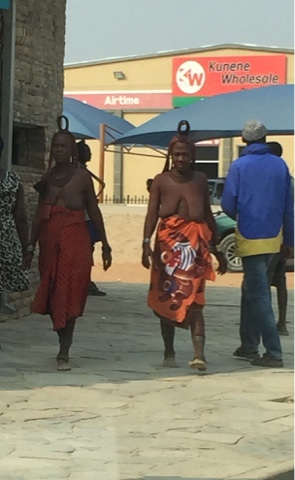
Our first stop was at Opuwo to fill up with diesel, buy NTC air time and cool drinks. The town, although extremely dusty had no litter. We had an extended stop at a 4 way intersection while 2 piglets crossed the road.  What strikes you most are the eclectic mix of cultures; Damaras, Ovambos, Hereros, Himbas and 6 South African whities.
The two cultures that stand out are the Hereros and Himbas due to their difference in dress from western culture.
Hereros are traditionally cattle herding pastoralists, their status in the community being rated on the number of cattle owned. They were however, heavily influenced by western culture during the colonial period, pretty much creating a new identity. The women, especially, wear dresses along the style worn by colonial Europeans.  They have however, added their own African flavor in terms of the bright and beautiful African print materials used.
The Ovahimbas are indigenous to Northern Namibia, with an estimated 50 000 living here. They are semi-nomadic pastoral people. In remote regions, they are considered amongst the last of the hunter-gatherers. They are polygamous, with arranged marriages and females in the tribe perform most of the labour intensive work, this is reminiscent of the Masai of Kenya and Tanzania. The Himbas wear traditional clothing that befits the hot semi-arid climate of Kaokoland. This consists of skirts made traditionally from calf skins. They are most famously known for covering themselves with otjize paste; a mixture of butterfat and ochre pigment, perfumed with aromatic resin of the omasum shrub. This gives their skin a red/orange/rust colour and apparently cleanses the skin over long periods, due to a scarcity of water and protects them from mosquitoes. Hairstyles and jewelry play a significant role, indicating age and social status in the community. Women wear headpieces, sculptured from sheepskin, with streams of braided hair, colored and shaped with otjize paste.
The road out of town was sandy and in need of repair, there were road works being done, and numerous narrow low lying bridges, all in all, making driving conditions bumpy and difficult. This was the busiest road we have been on since Swakopmund. The surrounding area was predominantly mopani  and acacia trees, with no ground vegetation. There were numerous herds of goats and we were continually stopping or slowing down for them, they were tended to by boys, some looked as young as around 5 or 6.
At Okangwati we turned right and drove along a few kilometers of lush vegetation with palm trees, before long it had returned to Mopani territory, with a few baobabs. We passed the zebra mountains on our right, well known for their striped appearance.
Eventually we came over a rise and the dry red sand of the past 4 hour drive turned into an oasis of green palm trees. We arrived at Epupa Falls lodge around 1. OMG!!! this is absolutely beautiful, a real running river after almost 3 weeks of desert and dry river beds. From desert to jungle – we are so privileged to be experiencing such remote and amazing places. We’re have now travelled from the southern most tip to northern border of Namibia.
Our thatched roof, wooden-reed hut is on stilts, right on the banks of the river. We have a view overlooking the top of the Epupa Falls on the Kunene. The room is open aired with no windows. On the opposite side of the river we look into Angola. Gray recalled being in this area of Namibia and unofficially in Angola, in the early ‘80’s, while fighting in the bush war. At one point they landed a helicopter here to pick up the body of one of their soldiers who had been washed over the falls.
We went for a drink to the central wooden stilted bar and food area. Here we saw a rufous-tailed palm thrush – this is the only place in the world where they are found, another lifer for us all. The temperature is in the early 30 degrees and I would love to go for a swim in the river but we have been warned about big crocs lurking around.
After spending some time reading, really being more distracted by the view, the birds, the flowing water – I gave up. The heat got the better of us and we took a walk to the edge of the falls and couldn’t resist a swim. The water was wonderfully cool and refreshing. We had some local Himba children come and watch us. When the men arrived and started stripping down for their evening wash, Al and I got out pretty quickly. George and Sue had gone on a bird finding walk down the river.
Dinner and drinks on the deck saw the last of the sun’s rays and an almost full moon rising between the makalani palms. Thankfully the heat had been replaced by a cold breeze and the spray from the falls.
I went to bed in our ‘George of the Jungle’ hut and was lulled to sleep listening to the sounds of the waterfall.

Day 18: Sesfontein to Opuwo.

Today was to be a chilled day. A 130km trip to Opuwo, estimated 3 hour journey.  We were relaxing, chilling over coffee, round the fire. The laugh this morning was on Panda, he alighted from our tent wearing a ‘2 tone’ khaki shirt – a BIG no-no in our circles. Then it started to rain, this only happens when the Morrison’s camp. As it let up, I went for an open air shower, rudimentary constricted, but warm.
Then it started raining again, so we packed up in the rain, dust turning to mud – camping can just be so much fun. As we set off off the rain stopped and the sun peaked through the clouds.
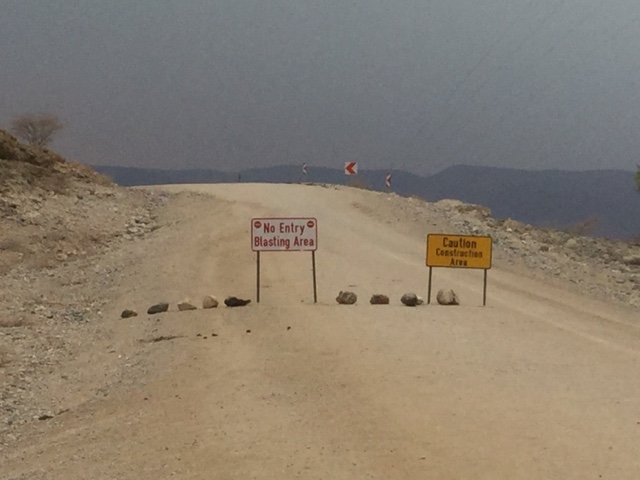
As we headed along the well maintained dirt road, we discovered the other half of Sesfontein; more houses, a school, a few shops and a police station. After a couple of kilometers we turned left onto the Opuwo road…..and it was closed, due to blasting. So much for the chilled day.
Plan B took us on a detour of the C43, it was a mountainous area, the mountains as opposed to what we were used to, were filled with trees. The road was stony and rutted. At our first travel break, I got out the car and stepped into elephant dung, wearing slops.  My Salamon’s are in serious need of a clean after yesterday’s stuck vehicle episode – funny all the girls have different footwear on today.
We passed a tiny village with a few scattered huts. Outside one, was a lady dressed in traditional Herero dress, sitting on a chair with about 10 children, gathered around her, seated on the ground. The local school, no playground and no facilities – our children at St Stithians do not know how fortunate they are.
The areas we passed through were very rural, dotted villages with cattle, goats and donkeys. Some of the trees had started sprouting blossoms – I guess we are a week away from spring. Our second smoke break, had the bird watches all excited with lots of the little critters flying around the area.
We had passed over the Beesvlakte and through Ombombo. We saw kudu, springbok and ostriches.  As we got further north, I was excited to see my favorite trees, for the first time in Namibia, the Baobab. With 14 km to Opuwo, we turned left onto a tarred road and headed into the first roadblock of the trip, we were waved through and headed off to find a campsite for the night. 
Opuwo is the biggest town in the Northern Territory and capital of the Kunene Region – it is a typical African town – rural town merging with modern centers, bustling and busy. We drove through the town, passed through a suburb of small houses, with not a blade of grass. We drove up a mountain track, according to GPS coordinates, to the only camp place we could find (according to the Namibia  Book Guide). We arrived at a padlocked gate to a rather dodgy looking place. I phoned the number in the book and a central reservation person told me that they had sold the hotel and attached camp site a few years back…. Chilled day ??? Then Soxy, a guardian angel appeared at the gate, she informed us that there was a lodge was across the next hill, we made space in the car, she hopped in and took us along a rather precarious road to the Opuwa Country Hotel and Camp site. 
This looked a whole lot more inviting, in fact so inviting that the girls promised the men body and soul, literally, to stay in the rooms for the night.  I have always said I don’t mind camping for 4 nights, then I want a proper bed and hot shower – wish granted. 
We moved into our rooms and headed off to the verandah for lunch.  It has a spectacular view over an infinity pool in to the valley below. Two o’clock and they refused to serve us lunch as the chef had knocked off. No problem, we ordered drinks, fetched crackers, cheese and cold meat from the car and made our own lunch at the hotel. 
Tony, Al, George and Sue headed into the hot, dusty, busy town for a few necessities; like new slops and a mattress for George, the former stolen and lost  – a lost mattress??…don’t ask. For Al shopping is just a necessity.  Gray and I chilled on the verandah, playing with their charcoal grey cat and then in our air conditioned room – bliss.
As we had defrosted meat in preparation for our camp out,  we headed off to the camp area for a braai. Ironically this was the best camp site we have encountered so far – in our experience in Africa, camp areas attached to hotels are always the best and they give you full use of hotel facilities, such as the swimming pool, bar and restaurants. I think our braai was better than the hotel buffet. The meat from the butchery in Swakopmund has been amazing.
 We then returned to the hotel for coffee and to catch up on admin – with an extremely slow wi-if we eventually gave up. I really appreciated going to bed in a bed.
(Apologies for the duplication of photos in Day 16. Comms, or rather the lack of them, make posts difficult at the best of times).